Many freshers reach out sharing the same frustration, they have been applying to jobs relentlessly, only to receive rejections or, even worse, no response at all.
They add the right keywords from the job description. Their ATS score crosses 90. And yet, nothing moves forward.
Here is the truth: everyone is doing that. A high ATS score alone does not make your resume stand out.
The real problem is that most fresher resumes are optimized only for the Applicant Tracking System, not for the hiring managers who actually make decisions.
This article walks you through building a fresher resume from scratch, one that passes ATS, convinces HR, and makes a hiring manager say, “This is it.” Along with that, there is advice at the end that will put you ahead of 90% of other freshers.
Also Read: How to Apply for NAVTTC Skills for Tomorrow Program | Free AI and Tech Courses
Why Do Resumes Get Rejected? Understanding the Three-Stage Filter
Before building your resume, it helps to understand how resumes get rejected so you can avoid those pitfalls. A resume typically goes through three checks.

Stage 1: ATS Check
This is where 70 to 80% of resumes get eliminated. An Applicant Tracking System is software that compares your resume against the job description. If your resume is in an ATS-readable format and contains the right keywords from the job description, you will clear this stage without much trouble.
Many online tools are available that compare your resume to a job posting and give you a match score. Generally, a score of 80 or above means you have cleared this step. If your score is lower, you need to add relevant keywords from the job description to your resume.
Stage 2: HR Review
After passing ATS, your resume goes to HR, where another 10 to 15% get filtered out. HR is trying to understand whether you are actually a fit for the role. They check:
- Tech stack exposure: How much hands-on experience do you have with the required skills?
- Quality of experience: Is your experience real and meaningful, or just a title on paper?
- Internship, freelancing, and open source contributions: What is the quality of your work outside academics?
- Project impact: Did you follow tutorials, or did you build something genuinely complex and meaningful?
- Problem-solving ability: How is your DSA, competitive programming, and logical thinking?
- Authenticity: How genuine does your resume look? A fully AI-generated resume may pass ATS, but HR will reject it.
Stage 3: Hiring Manager Review
This is the most critical check, and no keywords help here. The hiring manager evaluates:
- Technical depth
- Code quality, especially in GitHub projects
- Project complexity
- Problem-solving maturity
In simple terms, do you have deep knowledge or just surface-level familiarity? Experienced hiring managers can tell the difference directly from a resume.
After this review, only 3 to 5% of applicants actually get an interview scheduled. A perfect resume is one that convinces all three: ATS, HR, and the hiring manager.
How to Build a Perfect Fresher Resume: Step-by-Step
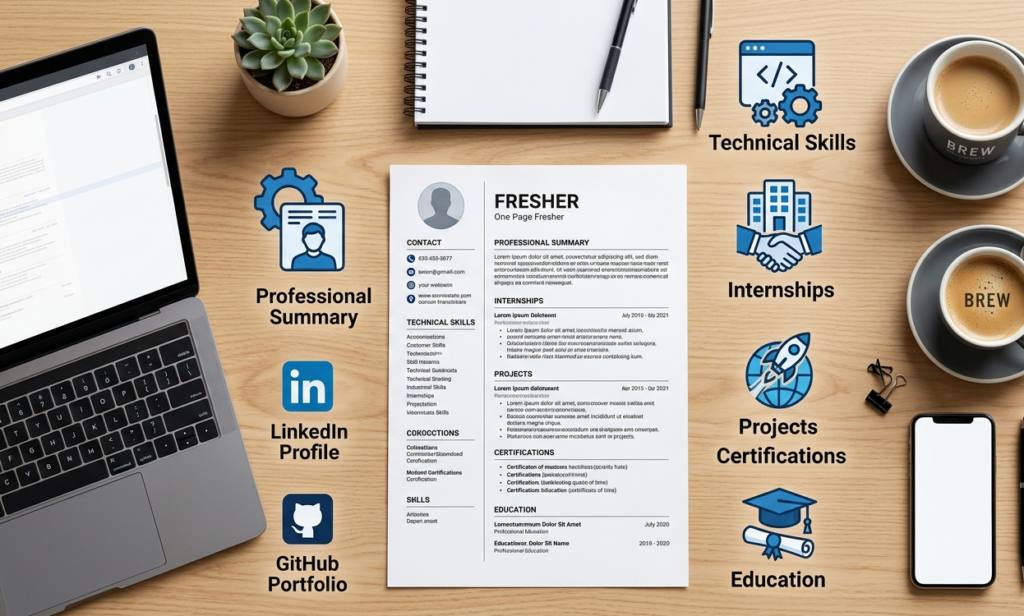
Step 1: Choose Your Format and Structure
Start with the formatting and structure. You can use a free online tool like Novoresume, JobScan, or Canva. Another great option is to paste your content into Claude or ChatGPT and generate an ATS-friendly resume from it.
Keep in mind that recruiters spend only 5 to 10 seconds scanning a resume. So keep it short and crisp, ideally one page, and put your most important sections at the top.
Step 2: Header and Contact Information
The first section of your resume should be a clean header. Include:
- Full name in bold at the top
- Address
- Professional email ID: avoid email addresses like rockstar2005@gmail.com
- Phone number
- LinkedIn profile
- GitHub profile or portfolio website (if available – this adds strong impact)
Keep this section clean and simple. This is where your first impression is made.
Step 3: Professional Summary
This section is where you sell yourself in two to four lines. The goal of a good professional summary is to make the recruiter understand in three seconds that you are worth interviewing.
Cover these points:
- Focus area: for example, Full Stack Development
- Relevant skills: for example, Java, Spring Boot, React, AWS
- Internship or strong project experience: for example, experience at Amazon optimizing back-end systems and database performance
- Relevant achievements: for example, 800+ DSA problems solved, Top 5% LeetCode ranking
- Career direction: for example, building scalable, reliable, and efficient APIs
Avoid generic filler words like hardworking, enthusiastic, or passionate. Focus only on facts, skills, and impact.
Step 4: Technical Skills
Because recruiters are primarily interested in your skills, keep this section near the top. Organize it by category:
- Languages
- Frameworks
- Tools
- Databases
- Others
Only add skills that are relevant to the job you are applying for. Many people make the mistake of listing video editing skills for a software developer role, this wastes resume space and the recruiter’s time.
Also, do not include outdated technologies. Only list skills that you can confidently answer interview questions about. Getting this section right will significantly improve your ATS score.
Step 5: Professional Experience
This is the most important section on your resume because it shows recruiters whether you have actually used real-world skills in practice. You can include:
- Internships
- Freelancing experience
- Significant open source contributions
Format it as: Role → Organization → Time period (start month, end month, year) → Location
To make your resume stand out, your experience should come from a reputable company, involve relevant tech, and show impactful contributions. If you have not done an internship, freelancing and open source work are valid alternatives.
If you have no experience of any kind, make it a priority to get some, even if it means working for free in the beginning. This is what actually makes a resume stand out.

How to Present Your Experience the Right Way
Most beginners write something like: “Developed a UI page.”
This tells the recruiter nothing about the page’s impact or quality.
A better version: “Developed a UI page that handles 1 million daily users and responds in milliseconds.”
This shows that your work had quality and real-world impact.
Three rules to follow in this section:
- The experience section should be about you, not about your team.
- Start every bullet point with an action word, Developed, Built, Designed, Optimized, Engineered, Led.
- Focus on scale, performance, and impact.
Example: “Built an AWS S3-based file storage and processing pipeline, reducing file processing time by 15% and supporting 5,000+ daily uploads.”
Step 6: Projects
Projects are the second most important section after experience. The most common mistake here is simply listing the project name, technologies used, and a GitHub link.
Here is the problem: recruiters usually do not click links because of security concerns. GitHub is also unfamiliar territory for HR. So if you do not clearly explain your project on the resume itself, it does not matter how strong the project is, you will not get selected.
For every project, include:
- Short, powerful explanation: What does the project do?
- Problem statement: What problem does it solve?
- Impact with numbers: for example, 1,000+ users, 4.8 out of 5 rating
- Date range: so the recruiter can see that real effort went into it, not just a one-week build
If you write this section well, your selection is almost confirmed.
Step 7: Certifications and Achievements
Add only relevant certifications here and place the most impactful ones at the top. You can also mention key achievements such as:
- Hackathons
- Coding competitions
- Awards and recognitions
Remember: relevance and impact matter more than quantity. Only add what is genuinely useful.
Step 8: Education
Mention your degree, specialization, and university. Include your year of passing. Add your CGPA only if it is 7.5 or above; otherwise, it is better to skip it. If your final year project is strong and relevant to the role, you can mention that here as well.
Important Tips for Freshers in a Competitive Market
When the job market is good, even an average resume can get you through. But when the market is competitive, as it is right now, you need a truly optimized resume, a good amount of persistence, and you will need to apply to a large number of jobs.
During tough phases, applying to 20 to 30 jobs a month for several months is not unusual. The mindset that works is this: even if one in a thousand applications leads to selection, that one opportunity can change your life.
Do not give up.
FAQs
Q: Should I always keep my resume to one page?
Yes, for freshers, one page is ideal. Recruiters scan resumes in 5 to 10 seconds, so a concise, well-structured single page is far more effective than a multi-page document with filler content.
Q: Is a high ATS score enough to get shortlisted?
No. ATS is just the first filter. HR and hiring managers also review your resume for real skills, meaningful experience, project impact, and technical depth. All three levels need to be addressed.
Q: Can I use AI tools to write my resume?
You can use AI to help structure or format your resume, but a fully AI-generated resume will likely be flagged by HR as inauthentic. Make sure the content reflects your actual experience and skills in your own voice.
Q: What email address should I use on my resume?
Use a professional email address, ideally your full name or a variation of it. Avoid informal or nickname-based email addresses, as they create a poor first impression.
Q: How many jobs should I apply to? There is no fixed number, but in a competitive market, applying to 20 to 30 jobs per month consistently is a reasonable approach. Volume combined with a strong resume increases your chances significantly.
Conclusion
Building a perfect fresher resume in 2026 is not just about stuffing in keywords and hitting a high ATS score. It is about creating a document that speaks to three different audiences, the ATS system, the HR reviewer, and the hiring manager, each with their own priorities.
Follow the structure outlined in this article:
- Clean header with professional contact details
- A focused, fact-based professional summary
- Categorized technical skills (relevant only)
- Impactful professional experience with action verbs and measurable results
- Well-explained projects with problem statements and impact numbers
- Relevant certifications and achievements
- Education with CGPA only if 7.5+
Write every section with real clarity and genuine content. Avoid inflating or fabricating anything. A resume that reflects true depth and honest effort will always outperform one that is over-optimized on the surface.
Stay consistent, keep applying, and do not let rejections discourage you.