
Germany is one of the most popular study destinations among Pakistani students, and for good reason. It is an affordable country with largely free education and a huge number of opportunities for international students.
However, because Germany is such a well-known destination, it has also become a hotspot for consultant fraud and overcharging. The root cause is simply a lack of awareness.
After reading this article, you will have full knowledge of where to apply in Germany, how to apply, and how to win those scholarships.
Every major opportunity covered here requires no blocked amount, so this guide is designed to save your time and your money.
Also Read: Best Resume Format for Freshers in 2026: A Step-by-Step Guide to Get Shortlisted
The Four Types of Germany Scholarships
Germany scholarships fall into four main categories. Understanding them helps you figure out which path is right for you.
1. Government-Funded Scholarships
2. University-Based Scholarships
3. Political Foundation Scholarships
4. Company/Industry-Funded Scholarships (Dual Study Programs)
Each is explained in detail below.
Also Read: 11 Fully Funded Scholarships for Pakistani Students Open Right Now in 2026
1. Government-Funded Scholarships
DAAD Scholarship
The DAAD (Deutscher Akademischer Austauschdienst) scholarship is one of the most prestigious scholarships Germany offers, and it is currently active and accepting applications.
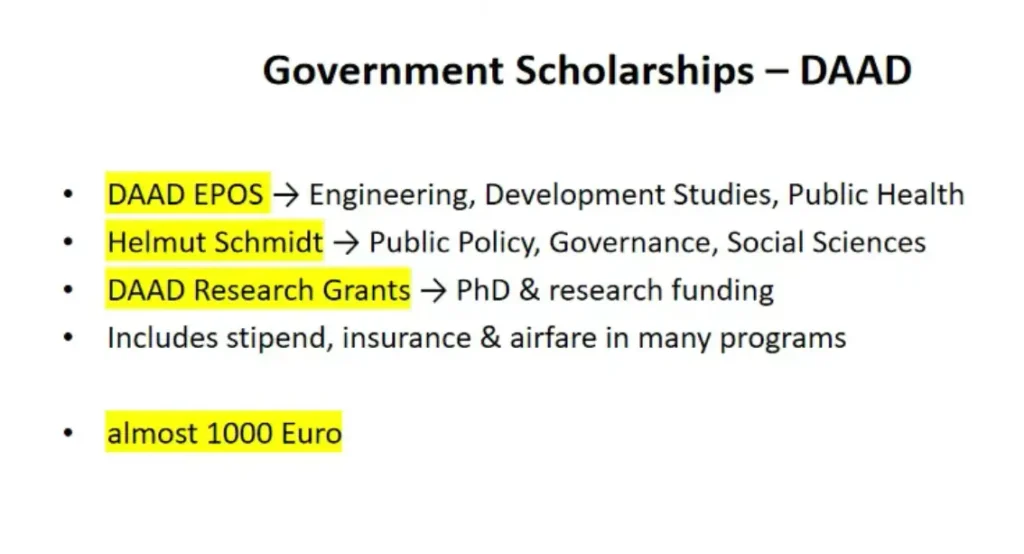
DAAD has multiple categories, and the category you apply under depends on your academic background and degree level. The two most well-known categories are EPOS and Helmut.
EPOS Category: This category is for candidates whose bachelor’s degree is relevant to engineering, development studies, or public health. A key requirement here is 2 years of professional work experience; this is mandatory. Without it, rejection is almost certain.
Helmut Category: This category covers public policy, governance, and social sciences. One major advantage here is that many programs within this category do not require work experience, so fresh graduates can also apply.
There is also a third category, DAAD Research Grants, which is mostly for PhD candidates. It is fully funded and offers similar benefits as the other DAAD programs, though eligibility criteria vary by program.
Key Points for DAAD:
- The monthly stipend is around 1,000 Euros, which is a very handsome amount.
- No blocked amount is required, it is a fully funded scholarship.
- You can apply to up to 3 programs simultaneously under DAAD.
- Your study gap should not exceed 3 months. If it does, you must explain what you were doing during that period.
- For any English-language program, IELTS or TOEFL is mandatory.
- Programs and degree listings fluctuate each year, so if your relevant degree is not listed this year, check again next year.
To find your eligible programs: Go to the official DAAD website, select Pakistan as your country, and filter programs by your field of study. The link is available on their official website. Everything is self-service, no consultant needed.
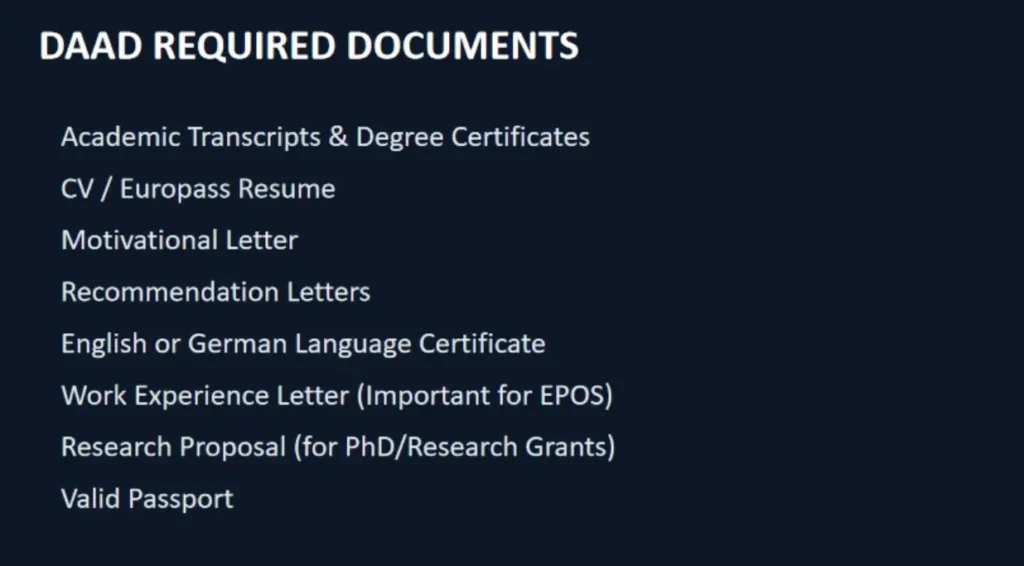
What you need to apply for DAAD:
- Strong academic grades
- Professional work experience (for EPOS category)
- A strong recommendation letter from a professor
- A well-crafted motivation letter
About the Motivation Letter: The motivation letter is often the game-changer. It must answer three core questions:
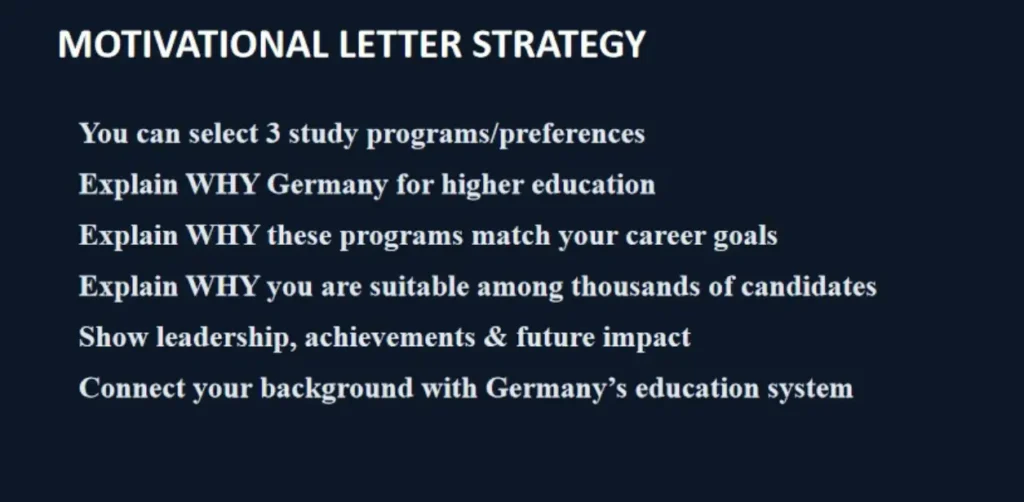
- Why Germany? Why do you want to pursue higher education specifically in Germany?
- Why these three programs? Explain why each is your first, second, and third preference.
- Why you? Among thousands of applicants, what makes you the right candidate?
Also important: German scholarship committees pay close attention to your extracurricular activities and community involvement. They want to see that you have been contributing to society, not just studying or gaming.
DFG (Deutsche Forschungsgemeinschaft)
DFG is another major government-funded organization in Germany that funds scholarships and research positions. It is one of the largest scholarship-funding organizations in the country.
2. University-Based Scholarships
German universities directly offer merit-based scholarships to international students. Most of these are not fully funded, they provide a stipend and waive tuition fees, but you will still need a blocked amount for the visa process.
The blocked amount is approximately 40 to 45 lakh Pakistani Rupees that you need to show in a German bank account. It essentially serves as a bank statement proving you can support yourself.
These scholarships are recommended for students who can arrange the blocked amount. They are generally less competitive than DAAD.
How to find these scholarships:
- Visit individual German university websites and search for scholarships.
- Look for organizations linked to German universities that offer additional scholarship support (around 300 Euros per month). These are applied for through the university itself, not directly.
3. Political Foundation Scholarships (Fully Funded)
Germany’s major political parties each head a foundation that offers scholarships to international students. These scholarships are fully funded, no blocked amount required, and cover everything.
Their primary focus is on leadership, academic excellence, and social engagement. If your research or academic profile aligns with these values, these organizations are well worth exploring.
These foundations regularly advertise opportunities on their own websites and even on LinkedIn. Some of the well-known ones include foundations linked to Germany’s major political parties, you can find a complete list on their respective websites.
4. Industry-Funded / Research-Based Scholarships
This category includes research-based scholarships funded by German companies and research institutions. There are abundant opportunities here for PhD candidates, and Master’s level opportunities exist as well.
Max Planck Institute
Named after the Nobel Prize-winning German physicist Max Planck, the Max Planck Institute offers research opportunities to international candidates every year. If you are from chemical engineering, chemistry, or physics, this is a strong option for you.
Fraunhofer Society (Fraunhofer-Gesellschaft)
The Fraunhofer Society is another well-known organization where many Pakistani students successfully apply each year. It offers abundant opportunities even at the Master’s level, making it one of the best options for Master’s students wanting to go to Germany.
How these research-based scholarships work: You need to find a supervisor, a professor or researcher affiliated with one of these organizations who has funding available. You pitch your research idea to them. If they agree to work with you, winning the scholarship becomes much more achievable. The key steps are:
- Find a supervisor in Germany working with Max Planck, Fraunhofer, or DFG.
- Confirm that the supervisor has available funding.
- Pitch your research idea and establish communication.
No consultant can find a supervisor for you. This requires your own effort and research.
After 12th Grade: Ausbildung (Vocational Training in Germany)
If you have completed intermediate (FSc) and want to go to Germany, the most popular and practical route is Ausbildung (vocational training).
Germany requires 13 years of education to directly enroll in a bachelor’s degree at a reputable university. A-Level holders meet this requirement, but FSc holders typically do not. Ausbildung bridges this gap.
What is Ausbildung? It is a vocational training system where you sign a contract with a German company. That company then:
- Enrolls you in a vocational institute
- Provides on-the-job training
- Pays you a monthly salary
You also get around 20 hours of work per week.
Popular fields for Pakistani students in Ausbildung:
- Nursing / Medical fields
- Hotel Management
- Information Technology (IT)
- Mechatronics
Monthly salary range: 700 to 1,400 Euros (varies by field and company).
Language requirement: For nursing and medical-related fields, a B1 or B2 level in German is typically required. German language proficiency is the single most important prerequisite for Ausbildung.
Can you do it without a consultant? Yes, absolutely. If you put in the research and learn German properly, you can secure a company contract on your own without paying any consultant. There are many successful stories of people who did exactly this and are now living and working in Germany.
Important Tips
- No consultant can guarantee you a scholarship. Scholarships are won based on your merit, your application, and your effort, not who you pay.
- Research everything yourself. A little time invested now saves a lot of money.
- For DAAD, visit the official website, select Pakistan, and filter programs relevant to your field.
- Study gaps of more than 3 months must be explained in your DAAD application.
- Extracurricular activities and community service genuinely matter in German scholarship evaluations.
- For research-based scholarships and Ausbildung, self-research and direct outreach are the most effective strategies.
- Avoid consultants and agents, especially if your goal is to study in a well-reputed institution that opens real future opportunities.
FAQs
Q1: Is education in Germany really free for Pakistani students?
Yes, most public German universities do not charge tuition fees for international students either. However, you may need a blocked amount to get a student visa if you are not on a fully funded scholarship.
Q2: What is a blocked amount and how much is it?
A blocked amount is a sum of money deposited in a German bank account to prove you can cover your living expenses. For Pakistani students, this is roughly 40 to 45 lakh Pakistani Rupees.
Q3: Can I apply to DAAD without work experience?
It depends on the category. For EPOS (engineering, development studies, public health), 2 years of professional work experience is mandatory. For the Helmut category (social sciences, governance), some programs do not require work experience.
Q4: How many DAAD programs can I apply to at once? You can apply to a maximum of 3 programs at one time under the DAAD scholarship.
Q5: What German language level is required for Ausbildung?
For nursing and medical-related Ausbildung programs, B1 or B2 level German proficiency is generally required.
Q6: Do I need IELTS for Germany scholarships?
For any English-medium program, yes, IELTS or TOEFL is mandatory. German-medium programs require German language certification instead.
Q7: Can I apply to the Max Planck Institute for a Master’s?
Max Planck Institute primarily offers research opportunities, which are more accessible for PhD candidates. For Master’s students, the Fraunhofer Society is a better option.
Q8: Is it possible to go to Germany after FSc (intermediate)?
Direct enrollment in a German bachelor’s program is difficult with FSc alone since Germany requires 13 years of schooling. The most recommended path is Ausbildung, a vocational training program that lets you live, study, and earn in Germany.
Conclusion
Germany offers a wide range of scholarship opportunities for Pakistani students, from the prestigious DAAD scholarship to university-based awards, political foundation grants, and research-funded positions.
For those who have completed their intermediate, Ausbildung is a practical and well-paying gateway into the country.
The key message is this: do your own research. Everything is available online, on official websites, and through direct outreach.
No consultant or agent is necessary, and paying for guidance that you can find freely is an unnecessary cost. Put in the effort, be thorough with your applications, and the opportunities are genuinely there for the taking.